

Farming for Climate and Health
The silent revolution of women small farmers from Andhra Pradesh
It sounds too good to be true: small farmers are overcoming poverty, hunger and malnutrition, freeing themselves from the debt trap together and defying climate change with their innovations from below.
Andhra Pradesh Community Managed Natural Farming (APCNF) is perhaps the world’s largest agroecological movement!
Monday, 23. Februar, 19 Uhr
KulturMarktHalle
Hanns-Eisler-Straße 93, 10409 Berlin

Two young women farmers, Bobbili Jyothi and Arika Narasamma, present and discuss their success story.
Speakers include Alexander Müller (TMC, former State Secretary and Deputy Secretary-General of the FAO),
Tim Heckmann, APCNF research partner from the Potsdam Institute for Climate Impact Research (PIK),
Swati Renduchintala and Sudhakar Yerrakonda, responsible for international exchange and educational programmes at APCNF operator Rythu Sadhikara Samstha
Moderator: Benny Haerlin from the Foundation on Future Farming, which is organising the ongoing APCNF European tour from 10 February to 5 March 2026.
The event will be held in English.
Afterwards, we invite you to join us for a glass of tea or a beer.
Please spread the word and join us whith anyone who might be interested!
For better planning, we look forward to receiving your informal registration at .
Background
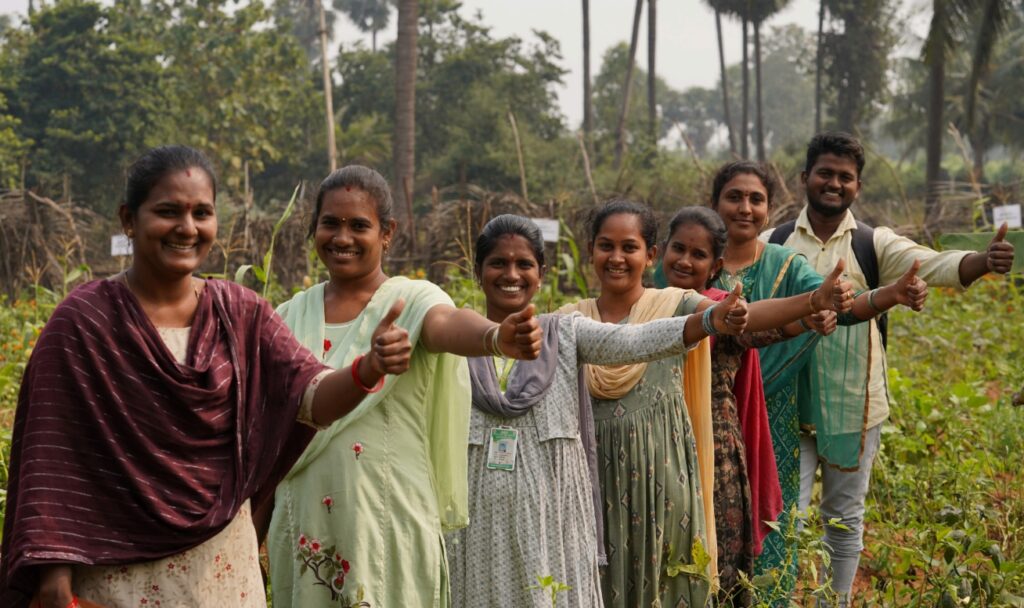
Over the past ten years, more than one million farms in Andhra Pradesh (for comparison: the whole of Germany still has 250,000) have converted to the nine principles of APCNF, which are very similar to organic principles here, but also go beyond them. Natural farming is based on diversity in cultivation, humus formation, targeted stimulation of the soil microbiome without chemicals or genetic engineering and solidarity among the women of the communities involved. They are successful because income and food security increase immediately and people and soil are healthy.
In the 1970s, Andhra Pradesh was the heartland of high-yield rice cultivation using artificial irrigation and chemicals. However, the productivity gains of this ‘green revolution’ have failed to overcome hunger, poverty or the excessive debt of small farmers, and are causing ever greater damage.
Above all, ‘chemical agriculture’, as it is called there, has no solution to the consequences of climate change in that region: extreme heat, droughts, cyclones and floods.
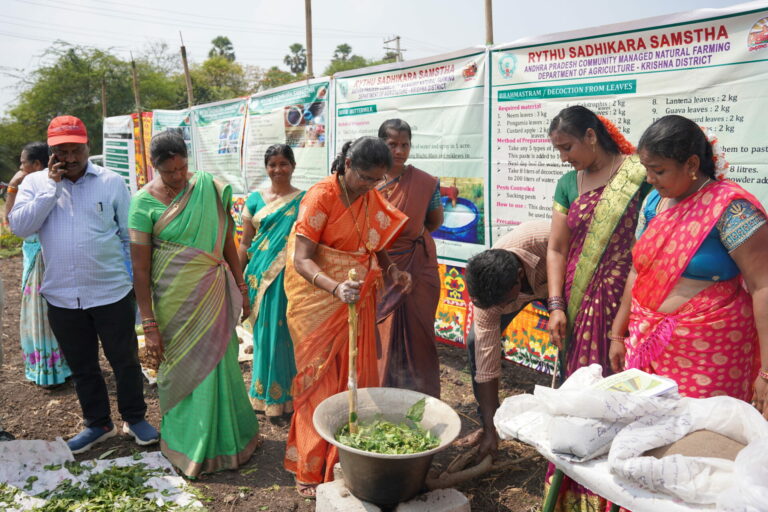
In contrast, the APCNF women farmers are working with scientists from around the world to develop grassroots innovations, which they test and optimize directly in practice. New seed mixtures and biological preparations, the use of drones, data and knowledge management with mobile phones are all part of their toolkit, as is the introduction of a complete additional growing season.
Learn more about this encouraging and inspiring garden and field revolution firsthand from Bobbili Jyothi and Narasamma Arika, who each farm half a hectare of land and an “Anytime Money” kitchen garden and were trained at the German-Indian Academy for Agroecology. By the way: The UN has declared 2026 the Global Year of Women Farmers – so let’s hear from and celebrate these pioneers from India!
Background information über APCNF and their European Tour
Video von Bobbili Jyothi
More information on Youtube:
More information about APCNF in general.